
The millions of commercial trucks that form the backbone of our economy are also at the center of a complex and growing crisis. This crisis is includes human stress, severe economic pressures, and environmental costs. When we see a semi-trailer on the highway, we see a vehicle, but we rarely consider the reality of the professional behind the wheel. For them, the cab is an office where immense pressure is the norm and a bad day can have critical consequences.
Behind the routine logistics of moving goods is a story of systemic challenges that ripple outward, affecting public safety and the environment. New research is pulling back the curtain on this world, providing hard data on these interconnected issues. The findings reveal a system under great strain.
Driver Stress: A Critical and Overlooked Safety Hazard
The mental and emotional state of a commercial driver is a major and often underestimated factor in overall road safety. The pressures of tight deadlines, traffic congestion, and unpredictable driving create a high-stress environment that directly impacts performance. New data from a Geotab safety survey of US-based fleet industry professionals confirms this is a measurable risk, not just an anecdotal issue.
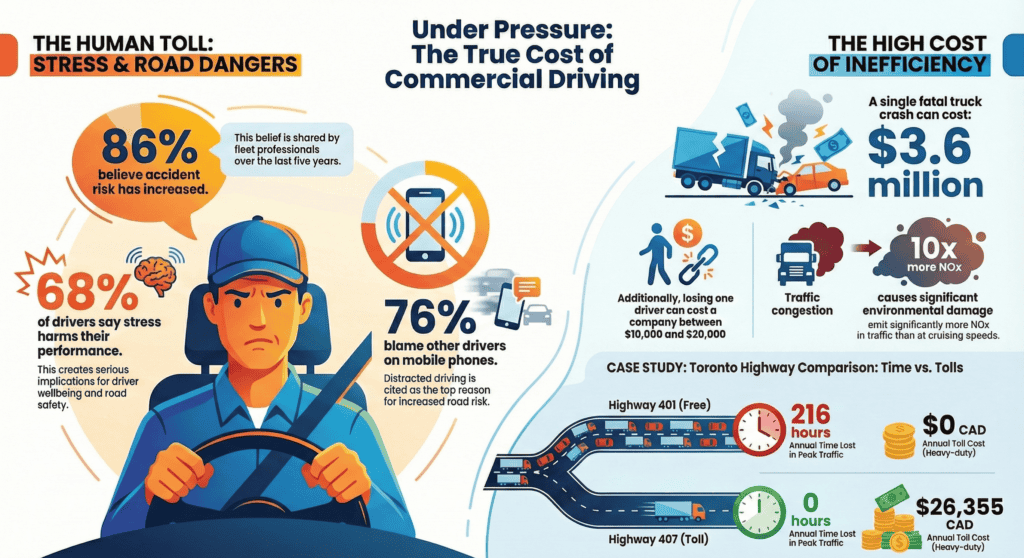
The research found that 68% of professional drivers report work-related stress negatively impacts their driving performance. More alarmingly, 78% of respondents believe stress and mental health are contributing factors to increased dangers on the road. These figures reveal a direct correlation between a driver’s mental state and public safety. This suggests that the industry’s traditional focus on mechanical safety and route optimization may be overlooking a critical human element that underpins the entire system’s safety.
Our research shows a direct, and critical link between driver wellbeing and overall performance. Prioritizing driver support is a strategic necessity for carriers to attract, and retain drivers, leading to better business outcomes and safer roads.
— Vik Sridhar, Product Leader at Geotab, in the company’s latest safety report.
The Financial Ripple Effect of Pressure
The pressure on professional drivers creates a significant financial impact that affects companies, consumers, and the economy. The direct financial bleeding is clear: for example, the average cost of a large truck crash involving a fatality is $3.6 million per crash, according to the FMCSA.
While companies face these direct costs from incidents, the data reveals they are also paying a steep premium to avoid them. A case study of Toronto’s highways quantifies the staggering price of productivity. To save 216 hours per year that would otherwise be spent gridlocked on the public Highway 401, a heavy-duty vehicle would face annual toll costs of $26,355 on the privately−owned Highway 407.This breaks down to paying an astonishing 122 per hour of saved time, revealing the tangible price of sidestepping congestion.
A Traffic Jam’s Not-So-Hidden Environmental Cost
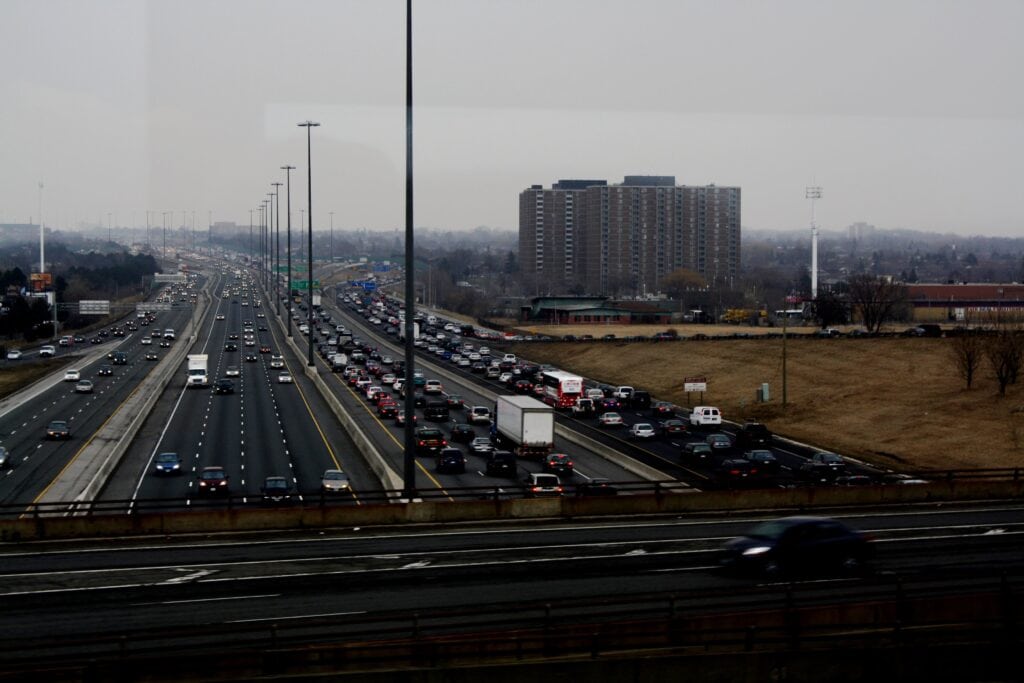
While many of us view traffic jams as a frustrating waste of time, new data reveals a severe and often invisible environmental cost. When heavy-duty trucks are forced to move at slow speeds in heavy congestion, their environmental impact multiplies dramatically.
A comparative analysis of the two major Toronto highways uncovered a startling fact: heavy-duty truck NOx (Nitrogen oxides) emissions are 10 times higher when trucks are moving at slow, congested speeds (1-40 km/h) compared to when they are moving at higher speeds (greater than 50 km/h) on an uncongested road. This means that traffic congestion isn’t just an inconvenience; it forces vehicles to operate in their least efficient state, dramatically increasing their emission of harmful greenhouse gases. Every minute a truck spends idling or crawling in traffic contributes disproportionately to air pollution.
Consensus on Danger, Contradiction on Cause
An overwhelming consensus has emerged: nearly nine in ten industry professionals (86%) see the roads as more dangerous than five years ago. When asked to identify the cause, however, the focus overwhelmingly turns outward, pointing to the behavior of others. The top reasons cited are other drivers on mobile phones (76%), poor driving by others (71%), and others driving too fast (51%).
This perception of external blame, however, is contrasted by a crucial admission of internal pressure. The same survey revealed that 26% of professional drivers admitted to regularly breaking speed limits to meet deadlines. This reveals a powerful cognitive dissonance at the heart of road safety: the danger is widely perceived as external, yet the systemic pressures of the job compel drivers to engage in the very same risky behaviors. This contradiction is a critical barrier to improving safety. It shows that awareness campaigns targeting “other drivers” are insufficient without addressing the root causes—like punishing deadlines—that force a professional driver’s hand.
A Clearer Road Ahead?
The view from the driver’s seat is complex, revealing that the challenges on our roads are an interconnected system of human stress, economic pressure, and environmental impact. The frustration of a traffic jam, the cost of a delayed shipment, and the danger of a stressed driver are not separate issues but different facets of the same core problem.
Fortunately, technology offers a path forward. The research shows drivers themselves are open to help, with 68% supporting new technology to improve their driving performance. Solutions like advanced driver-assistance systems (ADAS) can reduce the mental load on long hauls, directly combating stress. Telematics that provide real-time feedback aren’t just for efficiency; they can help mitigate the aggressive driving that burns 40% more fuel and is often a symptom of the immense pressure drivers face. By focusing on supporting the driver, we can create a system that is safer, more efficient, and more sustainable.